Hiroshima weather by month, charted
Miyajima sakura, rain, heat and red maples: your best month
Hiroshima, month by month
Twelve months around Hiroshima Bay
Choose a month to see sunset, daylight, the usual warmth, the rain and what the city and the island are known for then.
Sunset
Jan
Feb
Mar
Apr
May
Jun
Jul
Aug
Sep
Oct
Nov
Dec
Sunset is worked out for the 15th of each month on Japan time. Day length is calculated; temperatures are NOAA averages for its Iwakuni station, 33.2 km away, and rainfall is NOAA's Hiroshima station, 2 km from the center, 1991 to 2020.
Miyajima sakura in spring is one reason to choose a month; Hiroshima looks different each season: blossom and tulips in spring, rain then heat in summer, red maples on the island in autumn and oysters in winter. Here is what each month holds, with the numbers.
Editorial team, hiroshimatour.top · Updated November 2, 2026 · Roughly 7 minutes to read
Hiroshima in brief
- SpringCherry blossoms arrive between March and May depending on location, with tulips and roses in Hiroshima.1,2
- Wet stretchJune brings 233 mm of rain and July 261 mm, the two wettest months in NOAA averages.3,3
- SummerAugust runs hottest, its average high being 30.7 °C and typhoons possible.3,4
- AutumnThe maples of Momijidani Park turn red, and the museum is open until 7:00pm.5,6
- WinterOysters are best in winter, and January averages a high of 9.7 °C.7,3
Spring or autumn, then check the details
If you want one answer, pick spring or autumn. In April the average daily high is 18.5 °C and in October it is 22.7 °C, which makes a day of walking in the open comfortable rather than a test of endurance.3,3 Those are also the seasons when the two big sights of the trip, the Peace Memorial Park and the island shrine, are easiest to enjoy at your own pace.
Details move the answer around. A traveler who wants blossom needs a narrow window in spring, one who wants red leaves needs November, and a traveler who hates crowds may choose the quieter edges of winter. Japan's national tourism board describes the seasons in the broadest terms: a cool, breezy spring, a stiflingly hot summer, an autumn that suits outdoor exploration and a winter of many sunny days.1,8
The rest of this page works through the calendar one block at a time, then through the one variable that has nothing to do with the month: the tide at the island. The tide decides whether the great gate stands in the sea or on wet sand, and it changes twice a day on every date of the year.
The blossom weeks and the spring festivals
For Miyajima sakura, the national tourism board says cherry blossoms bloom between March and May depending on location, and its Hiroshima page adds hundreds of thousands of tulips and roses to the spring list.1,2 March still feels cool, with an average high of 13.2 °C, and by April that rises to 18.5 °C.3,3 A light jacket is the whole answer to spring clothing.
Spring is festival time on Miyajima. The Kiyomori Festival parade runs on a Sunday in late March, and on April 15 the island holds both the Fire Walking Ceremony at Daishoin and a bugaku court dance at Itsukushima Shrine.9,10,11 Those dates are fixed, so you can plan a blossom trip around them if you like crowds and drums.
Spring also has rain. March gets 147 mm and April 159 mm, so a folding umbrella earns its place in the bag.3,3 The guided coach day on this site runs year-round on the same plan, and the order of its stops does not change with the blossom.
Rain, humidity and typhoon months
Japan's national tourism board puts the start of the rainy season in May to June, and it warns that August and September may bring typhoons that can thwart travel plans.1,4 NOAA's Hiroshima record agrees on the wet months: June averages 233 mm across 10 days of real downpour (2.5 mm or above), and July averages 261 mm over 9 such days.3,3
August is drier at 145 mm, but September returns to 172 mm.3,3 If you must travel in the wet months, pack a rain jacket rather than an umbrella, since the shrine walkways and ferry decks are open to wind. Take the plan that has an indoor stop, such as the museum, in case a downpour closes the sea views.
Bad weather also affects the mountain. The Miyajima ropeway suspends service in bad weather, and it closes for maintenance around February and July.15 Check its service page for your date before you plan the climb up Mount Misen around a rainy week.
Match month to wish
Your priority, your month
Pick the priority that matters most and read off the month.
If Blossom is my goal
From March into May, by location
Blossom dates move with location across Japan.1
If I prefer mild afternoons
Pick April, or October
If I want red leaves
November
Momijidani Park and the gorges are known for autumn color.5,14
If I want drier days
Winter, from December
December averages 45 mm of rain.3
If I want to avoid the heat
Skip July and August
If I want oysters
Winter
Oysters are best when harvested in winter.7
Midsummer: hot, bright and busy
July averages a high of 29.7 °C and a low of 23.1 °C, and August a high of 30.7 °C and a low of 24 °C.3,3 Those are averages, so afternoons will feel hotter on the pavement of the Peace Park, where shade is patchy. Daylight is generous, with the sun above the horizon for 14.3 hours at mid-July.3
The museum adapts to the season. In August it is open from 7:30am to 8:00pm, and until 9:00pm on August 5 and 6.16 The volunteer-led park tours are not offered in July, August and September, so a summer visit leans on audio guides or a coach day instead.17
August 6 is the one date that reshapes the city. The memorial event at the Peace Park starts in the morning and ends with a river filled with glowing paper lanterns, and traffic is regulated around the park that day.12,18 Many travelers choose to be elsewhere on that date or to attend in quiet; it is not a day for a packed sightseeing schedule.
Price a day out
What a season-proof day costs for your group
Enter your party size and compare four listings that run through the year.
4 choices in one view
What a season-proof day costs for your group
Enter your party size and compare four listings that run through the year.
- Hiroshima bus dayA full 8 hrs · per person, from $126
≈
View - Rival bus dayA full 8 hrs · per person, from $121
≈
View - Small group on trainsAbout 6 hrs · per person, from $87
≈
View - From Osaka or KyotoAbout 12 hrs · per person, from $274
≈
View
Every row multiplies the lowest per-traveler fare its seller shows by the size of your party, using the European Central Bank's published rate; final totals are fixed only at the seller's checkout.
The Hiroshima calendar
A year of Hiroshima in six moments
Close of March
Kiyomori parade
The island holds the Kiyomori Festival parade on a Sunday in late March.9
April 15
Fire and dance
Fire walking at Daishoin and bugaku at the shrine both fall on April 15.10,11
The rainy stretch
The wet months
August 6
Memorial day
The Peace Park memorial event ends with lanterns on the river.12
November
Red maples
Fire walking at Daishoin is on November 15.10
December 31
Chinka-sai
About 1,000 torches reach Mikasa-hama beach.13
Autumn leaves on the island and in the gorges
Miyajima autumn is built around Momijidani Park, which the Miyajima Tourist Association calls one of the loveliest fall scenes in Japan, with the red of the maples brilliant against the deep green of an evergreen forest.19,5 The oldest temple on the island, Daishoin, has maples that turn red in autumn too.20 On the mainland, the Sandankyo and Taishakukyo gorges are known for fiery colors, and the national tourism board tells visitors to go before the areas close for the winter.14
Autumn warmth stays kind. October averages a high of 22.7 °C and November 17.3 °C, with 111 mm of rain in October and 79 mm in November.3,3 The island's fire walking ceremony at Daishoin falls on November 15.10
Days shorten, so the shrine's hours do too. From October 15 to November 30 Itsukushima Shrine is open from 6:30 a.m. to 5:30 p.m., half an hour earlier than the summer closing.21 Build the afternoon around the last boat and the early close rather than trying to squeeze in one more stop.
Video
Autumn leaf hunting on Miyajima Island, the island of the gods
her.atlas on YouTube · Nothing loads from YouTube until you tap the player.
Spring brings the cherry blossoms as well as hundreds of thousands of tulips and roses to Hiroshima.
A kit list for each stretch of the year
What to bring in each part of the year
Wet and hot months4
- A rain jacket for June and July
- Water and sun protection for the summer afternoons
- Quick-drying shoes for wet pavements
- A look at typhoon news before late summer travel
Easy months3
- A light jacket for spring and autumn evenings
- The last ferry time, since shrine hours shorten after mid-October
- A tide table for the day of your visit
Cold-weather kit3
- A warm coat for cold January mornings
- The museum closing days around New Year and mid-February
- An oyster stop planned for the island
Winter: oysters, New Year and cool light
Oysters on Miyajima are best in winter, when they are harvested, and the island's oyster festival normally takes place on the second weekend in February.7,22 The festival planned for February 2026 was cancelled because enough oysters were hard to secure, so check the association's news before you plan a trip around it.23
January averages a high of 9.7 °C and a low of 1.7 °C, and it is the second-driest stretch of the year at 60 mm of rain, behind only December's 45 mm.3,3 The national tourism board notes that at New Year thousands take the ferry to Miyajima to visit Itsukushima Shrine, and that illuminations light up Peace Boulevard.24 On December 31 about 1,000 torches are carried to the beach at Mikasa-hama for the Chinka-sai fire ritual.13
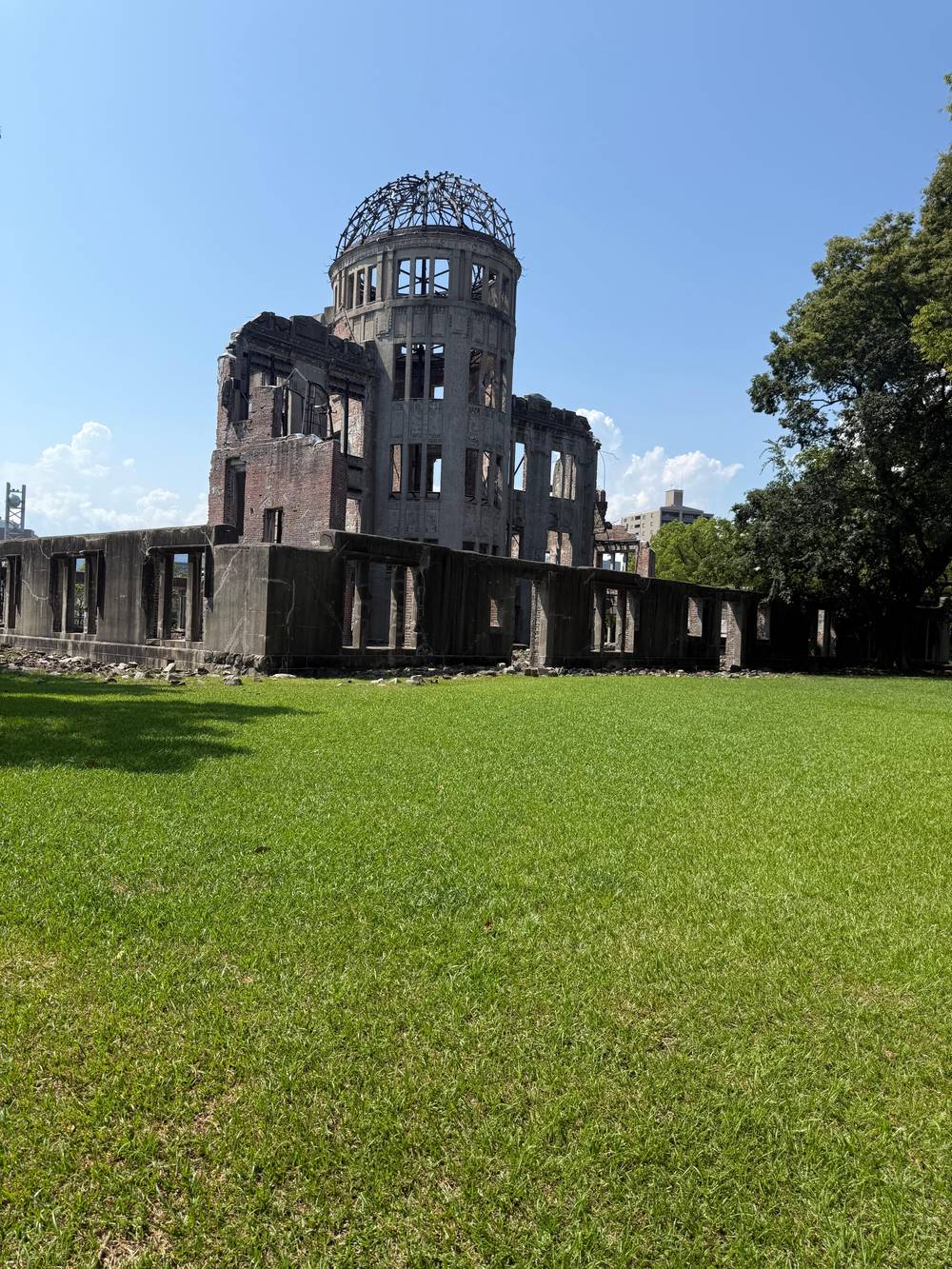
Closed days also cluster in winter. The museum is closed on December 30 and 31 and in mid-February, and the Miyajima ropeway pauses for maintenance around February.25,15 Winter rewards a visitor who wants the Peace Park without the summer crowd, and the gentle low light makes the ruin of the Dome look even starker.
The tide matters as much as the month
At high tide the shrine and its great gate appear to float, and at low tide the foundation and mud flats are exposed so you can walk up to the gate.26 The Miyajima Tourist Association's tide page lets you choose a day and shows the hours for walking to the gate and the hours when the shrine looks as if it floats, with the time and level of each high and low tide.27,28,29 Check it once you know your date, because it matters more than the month for the photograph you want.
The same page says that, with luck, the sunset can be seen behind the great gate.30 The largest annual festival at the shrine, Kangen-sai, is tied to a June spring tide high enough for deep-draft vessels.31 Whichever month you choose, the tide table beats any rule of thumb.
One caution applies to any date: the JR ferry route page still carries an old note about a restoration project at the great torii, although the repair has since been finished, so the gate itself should stand without scaffolding.32 If your dates are fixed and the water is wrong, a guided day still works: the 8-hour Viator coach tour from $126 visits both the city and the shrine whatever the tide.
FAQ
Questions we hear most.
What is the best month to visit Hiroshima and Miyajima?
When do the cherry blossoms bloom around Hiroshima?
Which months are the rainiest?
Is typhoon season a problem for a Miyajima day?
The national tourism board says August and September may bring typhoons.4
When do the maples turn red on Miyajima?
Is winter a good time for the island?
Oysters are best in winter, when they are harvested.7
How do I find out the tide for my date?
Does the coach day run in every season?
The listing gives cancellation free of charge until 24 hours before for a full refund.
Sources
- Japan National Tourism Organization · Weather in Japan (Travel Japan) ↩
- Japan National Tourism Organization · Hiroshima (Travel Japan) ↩
- NOAA · Global Summary of the Month, Station Hiroshima (rainfall) and Iwakuni (temperatures) (NOAA GHCN JA000047765 and JAW00043324), 1991 to 2020 ↩
- Japan National Tourism Organization · Weather in Japan (Travel Japan) ↩
- Miyajima Tourist Association · Momijidani Park ↩
- Hiroshima Peace Memorial Museum · Hours and Admission ↩
- Japan National Tourism Organization · Discovering Itsukushima Shrine, home to the floating Torii gate ↩
- Japan National Tourism Organization · Weather in Japan (Travel Japan) ↩
- Miyajima Tourist Association · Kiyomori Festival ↩
- Miyajima Tourist Association · Fire Walking Ceremony in Daishoin Temple ↩
- Miyajima Tourist Association · Toka-sai ↩
- Japan National Tourism Organization · Hiroshima (Travel Japan) ↩
- Miyajima Tourist Association · Festival and Event Schedule ↩
- Japan National Tourism Organization · Hiroshima (Travel Japan) ↩
- Miyajima Ropeway · Hours, Fares & Facilities ↩
- Hiroshima Peace Memorial Museum · Hours and Admission ↩
- Hiroshima Peace Memorial Museum · Guided Tours by Hiroshima Peace Volunteers ↩
- City of Hiroshima · Peace Memorial Ceremony ↩
- Miyajima Tourist Association · Momijidani Park ↩
- Japan National Tourism Organization · Miyajima ↩
- Itsukushima Shrine · Admission ↩
- Miyajima Tourist Association · Miyajima Oyster Festival ↩
- Miyajima Tourist Association · Miyajima Oyster Festival ↩
- Japan National Tourism Organization · Hiroshima (Travel Japan) ↩
- Hiroshima Peace Memorial Museum · Hours and Admission ↩
- Japan National Tourism Organization · Itsukushima-jinja Shrine ↩
- Miyajima Tourist Association · Tide Info ↩
- Miyajima Tourist Association · Tide Info ↩
- Miyajima Tourist Association · Tide Info ↩
- Miyajima Tourist Association · Sunset on Miyajima ↩
- Miyajima Tourist Association · Kangen-sai ↩
- West Japan Railway Miyajima Ferry · Route Information ↩
Keep reading